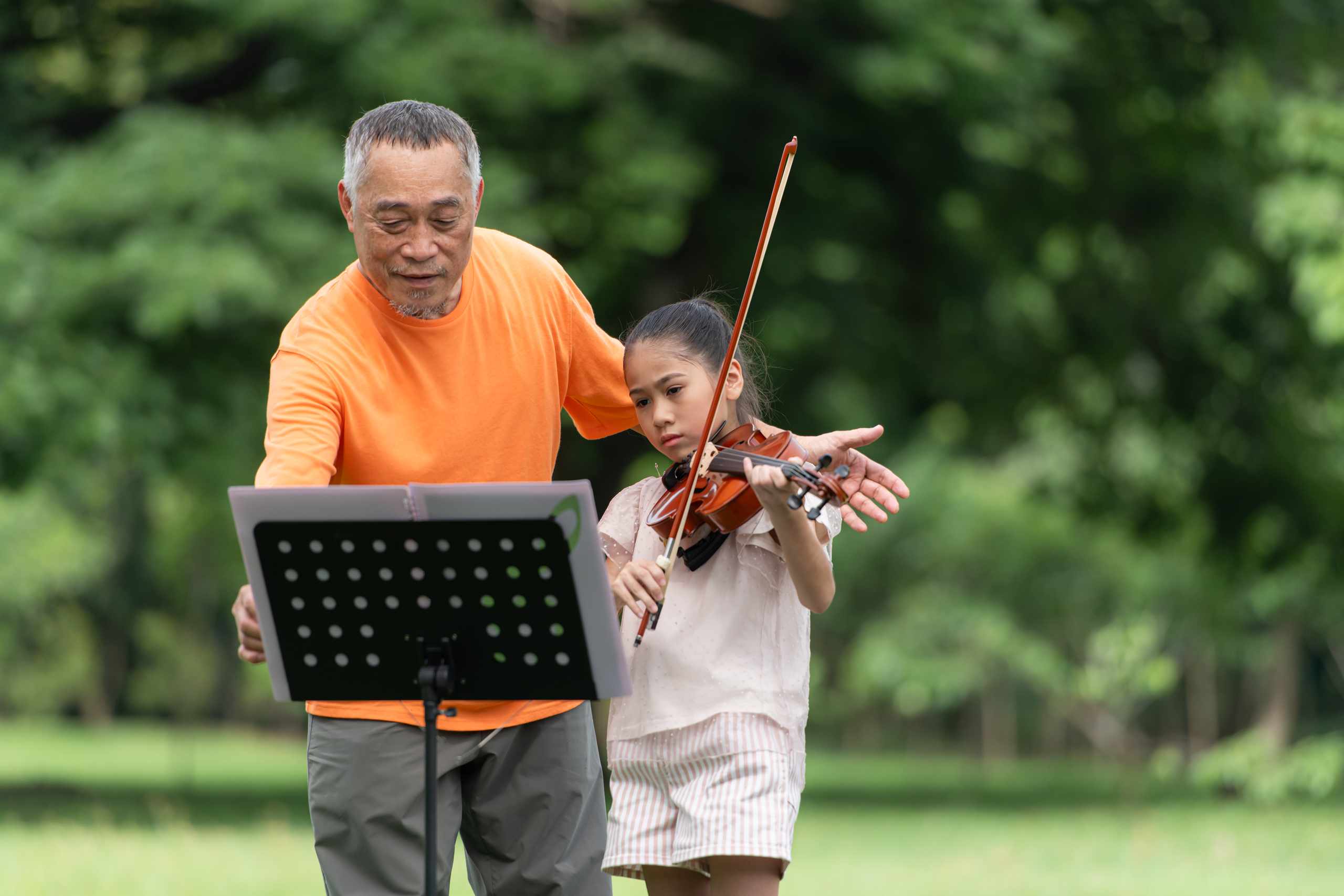
Your violin is likely to sound scratchy, thin or shaky at first and this is OK. Instead of trying to play quickly or play an entire song early on in your practice, it’s important to begin learning how to repeat a few movements carefully. Your practice will benefit more from paying attention to posture, bowing direction and listening than from spending long periods practicing on your own. The violin is a very small instrument so your practice should start out small enough to allow each note to be a learning experience. If you find yourself bowing unevenly, your fingers not in the right place or you aren’t happy with the tone you’re getting, these aren’t reasons to quit practicing. These are just good indications on where to go slower and look at the problem.
The best place to start is with open strings because you aren’t putting any attention on your finger hand. Make sure your posture is straight, hold the violin steady and put the bow in the middle between the bridge and fingerboard. Put the bow on the string and pull one bow very slowly, listening to what happens. Then pause for a second to assess what you heard. Did your bow go too close to your fingerboard? Did your shoulder move up? Was your tone crackly? A common error when trying to get a fuller sound is to squeeze the bow harder. This actually creates a more scratchy tone instead of a fuller one. What you need is the opposite of what you think is correct; less pressure, slower bowing and a straighter line. When your tone is scratchy, more pressure isn’t the solution; better balance is.
You won’t be ready to play with fingers until you feel a sense of control and stability with the bow arm. Start by learning how to place your fingers one at a time on a string and lift off without gripping too tightly. The point of this is not to speed but to learn what each fingertip does and what your hand looks like while the bow continues to move across the string. Your first tendency is to put more effort into the finger hand to get in tune which can lead to the wrist collapsing or your hand gripping the neck harder. This tension can travel quickly through your body and every note will sound worse. The better idea is to play very small note patterns to start, just two or three notes. Leave a pause between playing notes. Play your notes, listen and change as needed. When you find an out of tune note, don’t run through it to a note that sounds correct. Sing the note that you’re trying to play, put your finger down again and see what you get. You’re tuning your ears to your finger hand when you do this.
A shorter practice session can benefit you much more than a longer one. Playing the violin is all about regular practice not huge efforts every now and then. If you set aside 15 minutes of your day, you can practice a focused portion of the material. Start the 15 minutes on your bow arm, trying to create a consistent string crossing and connection with the string. Work on a finger hand exercise for a few minutes, working on playing a very small note pattern until you get a consistent feel. The last few minutes should be spent playing a very short phrase, two measures or less, as slowly as needed for a consistent tone. Though you don’t feel like you’ve learned that much, you are laying the ground work for playing future notes easier. It’s better to stop while you’re not yet bored than when you’re making mistakes.
Often, the problem is that you set your sights too high on one task. If your phrase continues to fall apart, take that phrase down to only the problem at hand. Maybe the string crossing is the problem; maybe the timing when you switch directions; maybe your fourth finger doesn’t make contact; maybe you shift the elbow when switching strings. Isolate that action and practice that part in a small form outside the context of the music. For example, you can play the rhythm on an open string, put the left hand down without bowing or shift your strings without playing. Doing this isn’t taking a break from music, this is how you learn to control your notes. Your violin won’t learn by guessing. It’ll learn by looking, analyzing and letting your hands practice each task separately.
A lot of new violin students are disappointed because they expect their progress to be dramatic every day. With the violin, this is just the contrary. You might find yourself starting your bowing cleanly, keeping your thumb and hand in a neutral position or even one phrase sounding just as beautiful as it does for your instructor. While this may be disappointing to you, this is exactly how practice sounds. Listen carefully, practice small sections and let repetition do the work. Keeping a steady tone on just one string isn’t a small thing; it’s the start of everything else in music.